
Closing the Gap Requires More Than Strategy
31 Mar 2026
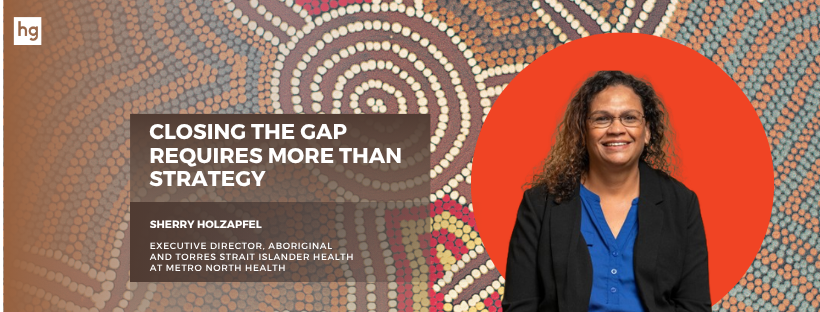
As we recognise Close the Gap this month, the focus turns to leadership what it takes to move beyond intent and deliver measurable, lasting change. We invited Sherry Holzapfel to contribute to this edition because her leadership sits exactly where this work happens: alongside community. A proud Yidinji woman with connections to the Kuku-Thaypan, Gungarri and Butchulla peoples, Sherry brings more than 25 years of experience across frontline care, executive leadership, and the Aboriginal community-controlled health sector.
Her work leading the Metro North Health Equity Strategy, reflects a deep, unwavering commitment to ensuring that community voices are not only heard, but translated into better outcomes, improved access, and culturally appropriate care. Here is what she told us:
- From your experience, what does effective leadership in advancing Aboriginal and Torres Strait Islander health equity actually look like in practice not just in strategy?
Effective leadership in advancing Aboriginal and Torres Strait Islander health equity is not something that lives only in strategy documents — it is something we must live and practise every day.
For me, leadership begins with understanding that it is my responsibility, duty and privilege to advocate for the voices that are not being heard. Being a conduit for Aboriginal and Torres Strait Islander people is not a role I take lightly. It is a gift — not a right — and I hold it with deep respect and humility.
True leadership in this space means staying grounded in who I am: my culture, my community and my family. My strength comes from the Elders who surround me with their wisdom, guidance and lived experience. They remind me that our work is not only about improving systems, but about honouring generations of knowledge, resilience and connection.
In practice, this means standing firm in my values and ensuring accountability and transparency in every decision that affects our community. Our people deserve honesty, clarity and follow‑through — not promises that sit on paper, but actions that create real change.
It also requires the courage to challenge systemic barriers that continue to disadvantage our people. Effective leadership is not comfortable leadership. It means being willing to ask hard questions, disrupt the status quo, and have the tough conversations — even when it feels uncomfortable or confronting.
Health equity will only move forward when we are prepared to face these truths openly and work collaboratively to address them.
For me, advancing Aboriginal and Torres Strait Islander health equity is lived through action, integrity and connection. It is listening deeply, learning continuously, and walking alongside community every step of the way. And above all, it is ensuring that our people’s voices — their experiences, their aspirations and their strengths — drive the decisions that shape the health system of today and tomorrow.
- What have been the most important enablers (or barriers) when working in true partnership with community to design and deliver better health outcomes?
Working in true partnership with Aboriginal and Torres Strait Islander communities is one of the most important responsibilities we hold as a health service. Over the years, I have learned that genuine partnership is built not through processes or frameworks, but through relationships, respect and a commitment to walk alongside community every step of the way.
For me, the strongest enabler is ensuring the right people are at the table from the very beginning.
This means inviting our community‑controlled organisations, Elders, Traditional Owners, and community members into the conversation early — not after decisions have already been shaped. It also means ensuring that our own organisational leaders are present. When our leaders sit with community, listen deeply, and understand the lived experiences and aspirations being shared, it strengthens our ability to design and deliver health care that truly meets community needs.
I am a firm believer that every single one of us has a role to play in improving health outcomes for Aboriginal and Torres Strait Islander people. That is why I advocate so strongly for our leadership team to be part of key community conversations from the outset. Their presence matters — not to speak, but to listen, learn and carry community voices back into the organisation so they influence action, not just discussion.
Time and time again, I am humbled by the generosity of our Elders and community members who continue to show up, share their time, wisdom and lived experience, and place trust in Metro North Health. Their support is one of our greatest strengths, and it reminds us of our responsibility to honour that trust through genuine transparency, accountability and follow‑through.
While the enablers are powerful, there are also barriers we must continue to confront.
One of the most persistent challenges is shifting mindsets — helping people understand why ongoing, meaningful engagement with community is not optional, but essential. True partnership is not a single consultation or a checkbox; it is a continuous relationship that shapes service improvement at every step. Encouraging others to embrace this approach can take time, courage and persistence.
And of course, we cannot ignore that systemic racism remains very real and very present in our public health system. It affects the experiences of our patients, our staff and our communities. Breaking down this barrier requires honesty, self‑reflection and unwavering commitment. It means calling out inequity when we see it, creating culturally safe environments, and redesigning systems in a way that values and respects Aboriginal and Torres Strait Islander ways of knowing, being and doing.
True partnership is not easy work — but it is the most important work we can do.
When we approach it with humility, accountability and a community‑led mindset, we create the foundations for better care, better outcomes and a health system that our community can trust.
- For health leaders and organisations committed to closing the gap, what is one shift in mindset or behaviour that would make the greatest difference right now?
If there is one shift in mindset or behaviour that would make the greatest difference right now in closing the gap, it is this: truly listen, deeply learn, and then act.
For too long, Aboriginal and Torres Strait Islander communities have been telling us exactly what needs to change to improve health outcomes. Our people are the experts in their own lives and their own health rights. They already understand the determinants that continue to impact their wellbeing — they have lived them for generations.
But listening must go beyond hearing words. It means respecting community expertise, valuing lived experience as equal to clinical knowledge, and recognising that solutions exist within community. Our role as health leaders is not to speak over these voices, but to listen with intent and humility.
The next step — and the most critical one — is to learn.
Learn from community stories, from the shared experiences of Elders, from the resilience and insight of families who navigate our health system every day. Learn from the truth of what isn’t working and the wisdom of what could.
And then we must act.
Words alone will not close the gap. Strategies alone will not dismantle barriers. We must be willing to remove the systemic and structural obstacles that continue to hold progress back. This means challenging discriminatory practices, redesigning services with community at the centre, and shifting power to where it belongs — with Aboriginal and Torres Strait Islander people.
For too long, we have found ourselves in a cycle of consultation without transformation.
Our communities have been delivering the same message repeatedly, across decades, and yet the gap remains. To break this cycle, we must move from talking about change to actually delivering it.
Listening, learning and acting must become part of our daily leadership practice — not a one‑off initiative, not a project, and not a slogan.
If health leaders and organisations can make this shift in mindset — to truly honour community expertise and to act with courage and accountability — then we will begin to see real, measurable and lasting change.
It is time to stop talking.
It is time to stop repeating the same patterns.
It is time to act.
