
Beyond the hospital walls
30 Sep 2026
South Australia’s health system has grown at historic speed, but Health and Wellbeing Minister Blair Boyer told an ACHSM leadership audience that investment alone cannot resolve the pressure. Aged care capacity, workforce supply and the courage to tell the human story must now sit at the centre of the reform agenda.
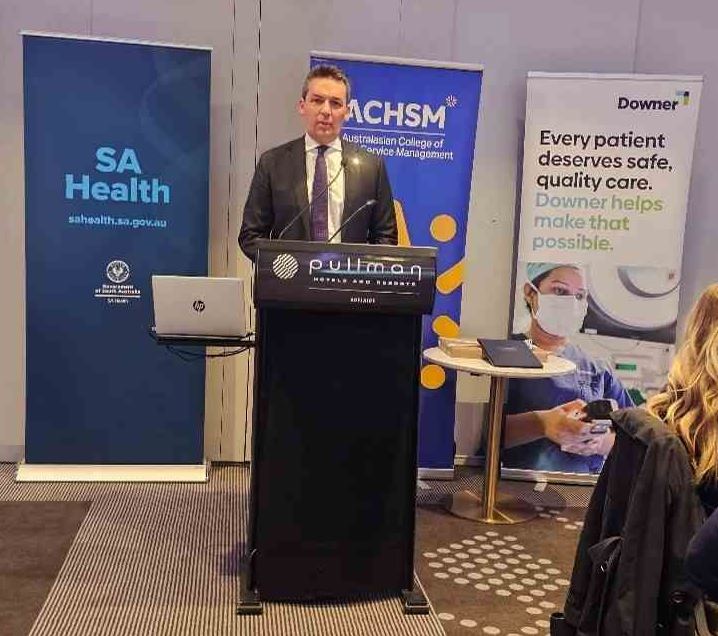
At an ACHSM South Australia breakfast attended by senior health leaders, the Hon Blair Boyer MP offered a candid assessment of a system managing sustained demand, intense public scrutiny and a demographic challenge that will shape service delivery for decades. His message was both pragmatic and urgent: South Australia has built substantial new capacity, yet the system’s performance will remain constrained if older people cannot move into the right care at the right time.
The address also marked an important leadership transition. Boyer paid tribute to retiring Department for Health and Wellbeing Chief Executive Dr Robyn Lawrence, recognising the steadiness, compassion and resolve she brought to one of the most difficult executive roles in government. Lawrence arrived in South Australia while the health system was still carrying the consequences of COVID-19, with rising demand, increasing access block and unprecedented public attention.
Boyer described her contribution as one that may be more fully appreciated with time. Under her stewardship, SA Health expanded at scale while continuing to respond to daily operational pressures. For the executives in the room, the tribute carried a broader point: leadership in health is often judged in the midst of crisis, before the long-term value of difficult decisions is visible.
Historic investment and unfinished work
The Minister was direct about the gap between investment and public experience. South Australia has added around 700 beds and more than 4,000 staff above attrition, while annual health expenditure has grown from approximately $7.3 billion to around $11 billion. Elective surgery activity increased by about 10 per cent in the most recent financial year, reaching record levels.
These gains matter. Without them, Boyer argued, the state would be facing today’s demand with far fewer beds, clinicians and alternatives to hospital care. Yet the persistence of ambulance transfer delays, long waits and elective surgery pressures makes the achievements difficult to communicate. The public sees the point at which the system does not meet a need; it does not always see the additional capacity preventing conditions from becoming substantially worse.
Health leaders must be able to hold two truths at once: unprecedented investment has strengthened the system, and the experience of too many patients remains unacceptable.
For health executives, this is a familiar leadership tension. Credibility depends neither on minimising the pressure nor dismissing the progress. It comes from explaining the relationship between the two and remaining accountable for what happens next.
Aged care is now a whole of system issue
The sharpest part of the discussion concerned older South Australians who are medically ready to leave hospital but cannot access residential aged care. Around 480 people were occupying public hospital or transition care beds while waiting for an appropriate aged care placement at the time of the address. Some had waited for many months.
The consequence extends far beyond one cohort. When a hospital bed is occupied because an aged care place is unavailable, a patient may remain in an emergency department, an ambulance may wait longer to transfer care and planned treatment may be deferred. Capacity added for acute care is progressively absorbed by a failure at the boundary between state-funded health services and Commonwealth-funded aged care.
The financial impact is equally significant. South Australia spent more than $123 million in the previous year caring for people in public facilities while they waited for residential aged care. As the number approaches 500, the annual cost is likely to rise markedly. But Boyer’s argument was not primarily financial. An acute hospital is not a dignified long-term home for an older person, and a system bed count cannot convey the disruption, anxiety and loss experienced by individuals and families.
The Commonwealth commitment to support 5,000 new residential aged care beds nationally each year is welcome, but the Minister noted that it remains below estimated need and will take time to translate into operational places. South Australia has also committed $250 million in no-interest loans to help accelerate construction of aged care facilities. The immediate policy question is what fills the gap: additional short-term beds, faster commissioning, expanded home support and practical measures that prevent people entering hospital or enable them to leave sooner.
Workforce is the limiting infrastructure
New beds do not create capacity unless there are people to staff them. The discussion therefore moved quickly from capital and funding to workforce and migration. Boyer cautioned against treating skilled migration as an abstract population debate while health and aged care services rely heavily on people who have come to Australia to work.
South Australia needs clinicians, carers and support workers at the same time that national debate increasingly frames migration as a source of pressure on housing and services. The Minister challenged leaders to make the missing connection visible: many of the people arriving in Australia are also the people delivering care. Without a sustainable workforce pipeline, newly built facilities will remain unopened or understaffed.
This is particularly important for South Australia. Its population is older than that of other mainland states, its demand for care will continue to grow, and its economy needs skilled workers. A uniform national response to migration risks overlooking the state’s distinct demographic and workforce needs.
Leadership means making the system human
The recurring theme of the morning was the power of individual stories. Data establishes the scale of a problem, but it rarely creates political or public urgency on its own. The Minister urged sector leaders to share, respectfully and appropriately, what delayed access means for real people: an older person waiting in hospital for a place to live, a family unable to secure suitable support, or a patient delayed in an emergency department because the ward bed they need is unavailable.
The same principle applies to workforce. The debate changes when migration is connected to the person caring for a parent, grandparent or partner. It becomes harder to speak about labour supply in the abstract when the consequence of its absence is personal, local and immediate.
For the health leaders gathered at the ACHSM breakfast, this was perhaps the most important challenge. Executives must manage performance, budgets and risk, but they also shape how the system is understood. Leadership requires translating complex interdependencies into a story the community can see and decision-makers cannot ignore.
South Australia’s next phase of health reform will not be achieved within hospital walls alone. It will depend on stronger connections between acute care, aged care, community support, capital planning and workforce policy. It will also depend on leaders who can acknowledge the unfinished work without losing sight of what has already been built.
The test is no longer simply whether the system can add more. It is whether every part of the care continuum can move together—and whether health leaders can keep the people behind the numbers at the centre of that work.
